The employer brand that aims for 4.5 stars, not five

Gordon Glenister • August 11, 2026

The half star is a retention decision

Most employer branding aims for five stars. Stu Hazel, Director of Talent Brand at Workday, would rather have four and a half.

"That 4.5 star rating is far better than a five star, it's more authentic," he says. "Not everything is perfect."

It sounds like a small preference. It is actually a decision about what the content is for, and it changes what ends up in the edit.

Hazel's reasoning has nothing to do with modesty. It is about what happens after someone accepts the offer.

"We have a responsibility within employer branding to influence the retention side of talent as well," he says. Attraction is only half the job. When people arrive carrying a wonderful ideology of what the place will be like and the reality does not match it, that gap does not stay quiet. He says that influences retention negatively.

So the team builds the difficult parts into the content on purpose. They are editing videos, Hazel says, around what the hardest project someone has worked on has been, or the most challenging thing. As he puts it, "we want the good and bad."

Workday builds human resources and financial software used by 75 million users, serving Fortune 500 enterprises and smaller businesses alike, and employs around 20,000 people it calls workmates. At that scale the pull towards a brochure is strong. Hazel pushes the other way, and asks other companies to do something harder still: get comfortable saying what you are not.

"Build some friction into what you're presenting because we don't want everyone."

Few employer brand teams would put that in writing. Workday can, because the pressure is uneven. "We haven't got an application issue across the board," Hazel says. The difficulty sits in niche skills where the skills themselves are scarce, and that changes what the content has to do.

Everyone has already seen the day in the life

Ask a company for authentic employee content and you tend to get the same film. Someone arrives at a nice office, has a coffee, has some snacks, has lunch with the team, sits in a few meetings.

Hazel's objection is not that it is dishonest. It is that it is identical everywhere. His question instead is what makes your day different from everybody else's, and the honest answer often includes something that went badly. A tough customer call, he suggests, belongs in the video rather than on the cutting room floor. "That is the real stuff."

The alternative is content built around the role rather than the building. What is it like to actually be a software engineer? What is it like to actually sell enterprise software as an account executive?

There is an influencer marketing parallel here, and Hazel makes it himself. A large part of that field rests on the person telling the story being authentic to the audience hearing it, and "you can't get more authentic than someone talking about their job."

Start narrow, not wide

For companies with nothing in place, the advice is unglamorous. Pick a small group, build a minimum viable product, get stuck in and start learning.

The instinct he warns against is the company-wide launch. "It's not about opening up the fishing net super wide." Workday started where the need was sharpest, in hard to fill areas such as data science and machine learning, and went on to create a bespoke engineering brand for that audience specifically.

Budget is less of a barrier than teams assume. You may not have a social advocacy platform, but you probably have a Slack channel, and social sharing can run through that until the case for tooling is proven. "There's always steps people can take and you don't necessarily need all the budget in the world," he says. "It's just about being proactive and organized."

The other early move is internal referrals: ask each participant who else in their team would be worth speaking to. It spreads through people rather than through announcements. Then something useful starts happening on its own. Colleagues see a good video, see the engagement it earns, and want a piece of that for their own personal brand. Hazel calls it the fear of missing out effect.

The barrier is rarely willingness

Plenty of people are proud of where they work and still have no intention of standing in front of a camera. Others would rather write long form. Others would happily do a call and have someone turn their answers into a blog afterwards.

They are not one audience.

Enablement, in Hazel's framing, is not an extra on top of the tool but the thing that makes the tool work. Even an intuitive platform carries what he calls barriers of entry, and no licence solves for someone quietly wondering who would want to listen to them.

The internal case has to be personal too. Better careers content means potentially better people sat alongside you, which is a benefit the advocate actually experiences. "You've got to show what's in it for me," he says. "There's always a why."

Measured against what the reach would have cost

Asked how any of this gets measured, Hazel's answer converts reach into money. The team looks at the impressions its content gets through the networks of workmates sharing it, then calculates what buying that exposure would have cost on the channels it normally advertises on, mainly LinkedIn but also Reddit and elsewhere. Last year that came to an earned media value of around 300,000 US dollars.

Participation is engineered rather than hoped for. Anyone who is a recruiter now carries an advocacy goal, signed off by the vice president of talent acquisition. The programme runs its own channels, one built around Workday life and culture, another used to share open roles with assets and copy tailored to the person being hired. Job sharing on LinkedIn is not universally admired in his field, Hazel notes, but the team has data showing it works. Across those two channels, engagement is around the 2,500 mark.

Recognition is constant and tangible. A swag rucksack goes out every quarter, and star points get directed towards people who commit real time. Over a hundred workmates took part in a shoot at the back end of last year to support the talent brand refresh, and backpacks and newsletter features followed.

Timing matters as much as reward. "We don't want to be tapping people in sales at the end of quarter saying, oh, fancy doing a bit of UGC for us," Hazel says, using the industry shorthand for user-generated content. "They're trying to hit their quota." Plan ahead instead, and the answer changes.

Five or ten minutes beats a list of five titles

The most transferable idea in the conversation is also the smallest.

Sending someone five suggested blog topics fails twice over. They may not want any of them, and they may not be a confident writer in the first place. The alternative costs five or ten minutes: ask what makes them them at work, and what they are passionate about.

Some will not want to talk about their career at all. They would rather talk about the industry, or their predictions for it, or a project they are excited about right now. That is still advocacy, and it sounds like a person rather than a campaign.

Build something that will resonate with the audience you have in mind, then meet them halfway on what they want out of it. That, Hazel says, is where the magic happens.

Stuart Hazell wearing glasses, smiling, in a blue blazer. Text:
By Aguilar September 22, 2025
When it comes to employer branding and recruitment marketing, few names resonate as strongly as Stuart (Stu) Hazell . With over 15 years of experience, Hazell has consistently proven himself as a forward-thinking leader who blends creativity with data-driven impact to redefine how organizations connect with talent. A Career Spanning Global Powerhouses Hazell’s professional journey is a testament to his ability to thrive in both digital and traditional marketing. Having held key roles at CA Technologies, IBM, and Workday , he has built and strengthened employer brands that not only attract but also resonate with talent across diverse global markets. Each chapter of his career has deepened his understanding of how to align corporate identity with the values, aspirations, and expectations of the modern workforce. Strategic Creativity Meets Measurable Impact What sets Hazell apart is his ability to blend strategic creativity with data-driven precision . Employer branding isn’t just about eye-catching campaigns, it’s about creating an authentic, sustainable narrative that reflects company culture while also measuring its impact on talent pipelines and recruitment outcomes. His work bridges that gap, making employer brands both inspiring and effective. Recognition and Influence As an award-winning leader , Hazell has been celebrated for his innovation in employer branding and recruitment marketing. His achievements demonstrate a rare ability to stay ahead of trends, adopt emerging technologies, and bring fresh thinking to a discipline that is increasingly critical in today’s competitive talent landscape. Why His Work Matters Now In an era where candidates view the employer brand as seriously as they view consumer brands, Hazell’s contributions have never been more vital. Organizations are under pressure to stand out, communicate authentically, and deliver meaningful employee experiences. Leaders like Hazell are showing the path forward, where creativity and analytics meet to build brands that engage, attract, and retain talent worldwide. Conclusion : Stuart Hazell’s story is more than just a career biography, it’s an example of how visionary leadership in employer branding can shape the way companies and candidates connect on a global scale. To listen to the podcast click here: https://open.spotify.com/episode/5m4o6LinFkdnjA8sNfhmUn?si=JjY5V_MyTqW9jGw2qjlMvg
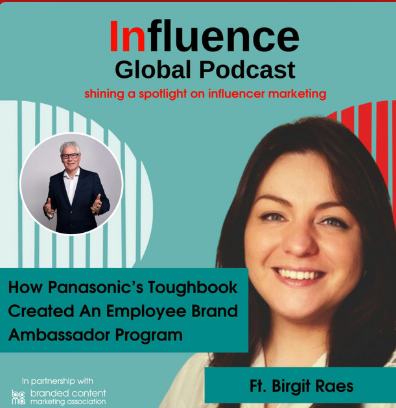
Podcast cover: A woman, Birgit Raes, smiles. It discusses Panasonic's Toughbook ambassador program. Text is red and teal.
By sebastianaguilarve July 23, 2025
In the world of B2B sales and enterprise technology, creating genuine connections with decision-makers is challenging. But what if instead of trying to go viral or flood your channels with content, you zoomed in way in? That’s exactly what Panasonic Toughbook did. In our latest podcast episode, we sat down with Birgit Raes , a top sales enablement specialist at Panasonic, to uncover how she and her team built a hyper-targeted employee brand ambassador program, resulting in 22 meetings booked with their most valuable prospects. What Made This Program So Different? Most companies launching advocacy or ambassador programs go broad. They chase impressions, likes, and “reach.” But Birgit and her team flipped that approach on its head. Instead of asking all employees to become advocates, they started with just five experts, people who were already credible voices online and had a natural presence on platforms like LinkedIn. And instead of pushing content to a wide net of leads, they narrowed in on just 25 key accounts . That’s five ambassadors, each focusing on five high-priority clients . Why It Worked The magic of this initiative wasn’t scale, it was relevance . Each ambassador created or shared tailored content that resonated deeply with their target segment. Since they were already trusted and established in their field, their posts didn’t feel forced or corporate, they felt authentic. This razor-sharp alignment between: the ambassador’s voice , the client’s challenges , and the content’s value meant that decision-makers paid attention. The result? 22 booked meetings from just 25 targeted accounts . That’s not just ROI, that’s precision marketing at its finest. Key Takeaways from the Episode Start small, start smart : Not everyone in your company needs to be an ambassador. Focus on the ones already speaking the language of your clients. Depth over breadth : Likes are great, but conversations with the right people are better. Aim for business outcomes, not just brand awareness. Content that converts is personal : When your employees speak authentically and insightfully about client challenges, you build trust before you even make a call. Want to Learn the Full Strategy? Birgit breaks down exactly how they selected the right ambassadors, how they briefed them, and how they tracked success without relying on vanity metrics. If you're building (or rethinking) your ambassador program, this episode is a must-listen. 🎧 Listen to the full episode now : https://open.spotify.com/episode/00juuZ0InBkRgfLiJd48ez?si=VH6LFLZ5Sj2K3nnTwLDLLQ